
blue christmas
it's the most ? time of the year!

When people learn that I love Christmas, they are often surprised. I remember once that a friend, upon learning of my fondness for holiday music, said, “Your love of Christmas is the most off-brand thing about you.” I wondered what led people to this conclusion. After all, I love girl groups and basic chord progressions and any reason to decorate. I love color coordination and giving gifts and wearing a cute hat. I’m also Catholic, for God’s sake, and haven’t missed Christmas mass once in my entire tenure of Being Alive So Far. But more than anything, I am deeply nostalgic. I think it’s easy to feel that in my writing. I consider my writing to be a way of exorcising the past, chaining my precious memories to the written word so that I don’t disappear into them. When I was eight, I was already nostalgic for being seven. It’s always been one of my greatest deficiencies, the obsession with looking back. So, of course, I love Christmas, the season in which all of those things coalesce.
It’s hard these days for Christmas not to feel like an exercise in masochism. The gap between my memories and the present reality of the holiday yawns so wide, and it only gets wider each year. Even as a child I had the uncomfortable sense that I was living through ‘the good part,’ that with the passing of time my affection for Christmas would become muddled with more complicated feelings. It probably wouldn’t shock you to learn that I was a very neurotic kid, and aging was one of my biggest fears, because I knew from watching my parents that growing up meant that my capacity for enjoyment might shrink. The Christmas season felt endless as a child, each day another opportunity for joy and anticipation, the Advent calendar nothing more than a torturously slow countdown. Now, like every season, it passes by in a blur, and it never feels long enough for me complete all of the things I need to complete, let alone enjoy it, I am broke by the end without fail. Then it is New Year’s and my birthday, followed by a bleak stretch of mirthless winter.
This year the Christmas season is hitting me particularly hard. There’s a lot going on behind-the-scenes that has made going home to be with family a more fraught experience than usual. Maybe some people have perfect families and well-behaved Golden Doodles, but I choose to believe that even they have their own domestic hang-ups. I give my parents a lot of credit for keeping everything bubbling just below the surface until I was old enough to stop believing in Santa Claus (age 12, I’m a zealot at heart), at which point they let it all hang loose. I know that both of my younger sisters had a different and less idyllic version of the holiday, but that didn’t stop my dad from slapping a coat of jolly paint over everything and reading Twas the Night Before Christmas even if we all had just gotten into an argument so loud thirty minutes earlier that the neighbors called to make sure everything was alright.
The first time I came home for Christmas after moving twelve hours away for college I was so weepy and despondent that it took me months to feel normal. It’s as if something inside of me ruptured, and that part of me was the thing that made me feel integrated into the festivities, which I would now forever experience as an outsider, looking histrionically through frosted glass. I suppose that everyone must feel this way, even the nostalgia-glutted millennials whose lives revolve around Elf quotes and decor that references holiday episodes of The Office and Friends, the type of people who rewatch Harry Potter every year or have season passes to Disney World. I don’t know if anyone can have a normal relationship to Christmas, and I am no better than they are. If you looked into the gooey chambers of my heart you’d find colorful rainbow bulb lights twinkling and a mall Santa waving cheerfully from his comically large chair. I’m not even very good at hiding these tendencies.
It doesn’t help that almost every single one of my Christmases exists on video, a grainy archive of what I now think of as some of the happiest moments of my life. But watching the footage now I can see what I was never able to articulate then, which is that I was clearly anxious, so anxious that I often acted out in front of my relatives and the camera. Thanks to my OCD, I grew up hating surprises, so anticipation was not a pleasant feeling for me. In the VHS footage I often come off as awkward and bratty, unable to produce the reactions that I thought my relatives wanted, so nervous about being ‘good’ that I acted bad just to have some sort of control over the outcome. It can be painful to watch now, because I can still remember how it felt: like something was distinctly off for me. That the things other children found easy were always going to be just a little bit difficult. The veil between myself and the world was thin.
But now I am committing a reverse pastoral fallacy, trying to color my Christmases darker, painting myself as some sad, rheumatic Victorian child when really I was mostly very happy, even hyper. Clearly the feelings were fuzzy enough that I’ve carried them with me into my adult life. Every December the sense memory comes back, and I expect it all to feel the same, though of course it never does. I remember one Christmas break when I was fourteen I went iceskating with a group of friends, one of whom was my illicit crush. He was a skater, and I had never skated before, so he held my hands and guided me across our suburban ice rink. At one point he asked if I’d like to be “slingshotted,” and before I could say yes he spun me around and flung me across the ice, skating so quickly beside me that he caught me at the wall before I had a chance to fall. My stomach had risen into my throat in the best way, and when I think of Christmas I think of this feeling, the levitation that comes right before the crash.
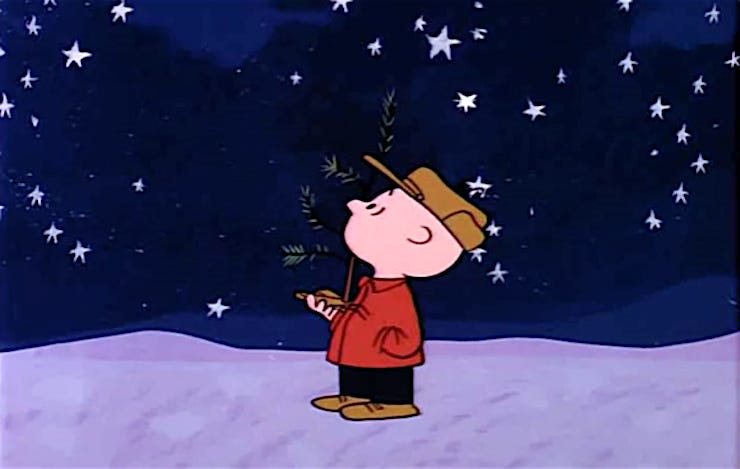
Ultimately what I find so moving about Christmas is also what can make it feel so torturous, which is its ubiquity. Many of us are drawing from the same trove of cultural signifiers, though we may feel an intensely personal relationship to these signifiers all the same. There is a reason that Instagram is clogged with Reels with captions like, “pov it’s the last day of school before Christmas break in 2005.” We all watched the Rankin & Bass Christmas specials and set out carrots for the reindeer and attended awkward community Christmas parties where we sat on some old guy’s lap. We all went on drives with our parents to look at lights and felt strangely empty and lonely watching A Charlie Brown Christmas. If you went to Catholic school then you probably set your shoes out to receive candy on St. Nicholas Day just like I did, or maybe your parents, too, were forced to attend the multi-grade Holiday Concert, where you were not a soloist during “You’re a Mean One, Mr. Grinch,” because the whole thing was rigged! My voice still never sounds better than when I am singing Christmas songs by Darlene Love or Ronnie Spector, because those were probably the first songs I ever sang out loud.
Forgive me for getting a little bit religious with it, but if there is one thing to salvage from the plaid-patterned, red-and-green Christmas wreckage it is the actual event of Christ’s birth. I think any excuse to give gifts is a good one, and I appreciate secular interpretations of the holiday, but when it all feels too consumerist and soul-destroying I think about that first Christmas gift, God’s decision to send his only son to the world in the humblest of vessels. It’s a profound offering, the gift of mercy, a reminder that God—or my God at least—is not fearsome, but forgiving. When I am feeling crushed and overwhelmed by the weight of what is happening in my life, I remember how Mary must have felt to become an integral part of this story. Every year at mass I become emotional thinking about the sheer symbolism. A young woman places her blind faith in God and delivers a child in a filthy barn, and this child causes kings to bend their knee and offer gold, frankincense, and myrrh. “O come let us adore Him” is the refrain to one of the most popular Christmas hymns of all time, and the ‘Him’ in question is literally a baby. Whether you put any stock in a literal interpretation of the Bible, its imagery is extremely potent.
On Sufjan Steven’s beautiful Christmas album Songs for Christmas, he has a song called “It’s Christmas! Let’s Be Glad!” I suppose it’s sort of tongue-in-cheek, but it’s couched amongst gorgeous, simple, earnest covers of classic Christmas carols. I don’t portend to understand Sufjan’s relationship with God, though I know he’s a Christian. But “It’s Christmas! Let’s Be Glad!” rings true to me. It a prayer, not a commandment. Christians once greeted each other by saying, “Glad tidings!” to declare a piece of joyful news. Gladness has a sense of ephemerality that’s pertinent to Christmas, a season that comes so fleetingly and melts away into more months of grey slush. Yes, everything is terrible, and many of us have imperfect relationships with our families, and celebration can feel deeply disingenuous. Trust me, I know this. But I try to model myself after the shepherds of the nativity story who kept watch by their flock on Christmas Eve, expecting nothing and yet still giving themselves over to wonder when the Lord appeared before them with news of Christ’s birth. All of this happened on an ordinary bleak midwinter night, and all the shepherds had to do was wait. Like the shepherds, I leave myself open to the possibility of joy and glad tidings.
looking forward to another mirthless winter!! 🩵